Posts Tagged ‘getting ready’

Slip Proofing Your Home

Jack and Jill, a Mother Goose nursery rhymeBy Brian Schiller

Here are just a few of the statistics:

  • Each year in the United States, one of every three persons over the age of 65 will experience a fall. Half of which are repeat fallers.
  • For people aged 65-84 years, falls are the second leading cause of injury-related death; for those aged 85 years or older, falls are the leading cause of injury-related death.
  • Falls account for 87% of all fractures among people over the age of 65 and are the second leading cause of spinal cord and brain injury.
  • Half of all elderly adults (over the age of 65) hospitalized for hip fractures cannot return home or live independently after the fracture.

Elderly people face an increased risk of slips, trips and falls due to diminished mobility, strength and balance that comes naturally with old age.  The increased risk of falling is coupled with a higher likelihood of health complications related to the fall. An elderly person faces twice the chance of death due to falls than younger people according to the Centers for Disease Control. Read the rest of this entry »

Brianna’s Smart House

I just returned from CES 2013, the big consumer electronics show, where I learned about the latest in health & wellness technologies and home automation products that can serve seniors and the disabled and support aging in place, when I saw this story on KCBD News Channel 11. They’ve been following the story of Brianna Graves, an active little girl who was diagnosed at age 9 with Gorham’s Disease, also known as “Vanishing Bone Disease.” Instead of focusing on what Brianna cannot do anymore, this story looks at what she can do from now on.

It’s a heart warming story of how technology and universal design concepts can make life easier – in this case for a young girl with some severe physical limitations.

Brianna controls her environment by moving her lip, as a computer monitors the movement. But just imagine what she’ll soon be able to do with the brain sensing technologies that I saw at CES. I’m excited about the pace of tech innovation and the positive impact on medicine, health care, and wellness. And I’d like to hear your stories of how technology has helped you or a loved one.

Home Renovations that can Save the Estate

Jack and Jill, a Mother Goose nursery rhyme

Jack and Jill went up the hill
To fetch a pail of water.
Jack fell down and broke his crown,
And Jill came tumbling after.

Up Jack got, and home did trot,
As fast as he could caper,
To old Dame Dob, who patched his nob
With vinegar and brown paper.

By Wayne Caswell

Scenario ONE

Jack and Jill were in their late 60s and had been married for 37 years when Jack suffered a severe stroke and required care beyond the abilities of his partner. After leaving the hospital, he went into a nursing home, and the family home was sold to pay for his care, which was expensive and projected exceed $84,000 per year.

Jill couldn’t maintain the big house herself and couldn’t afford it either, so she moved into a small apartment alone, without her lifelong mate. Being separated affected the couple’s morale, but worse was that it affected their health and their finances. Without long-term-care insurance, their life savings were depleted quickly before Medicaid finally kicked in. And now the grown children had two places to visit to support their declining parents. It didn’t have to be that way.

Scenario TWO

Just as in the nursery rhyme, Jack goes home and recovers more quickly there – in familiar and loving surroundings where Jane hires professionals to help care for him. That decision lets the couple stay together, and the kids have just one place to visit.

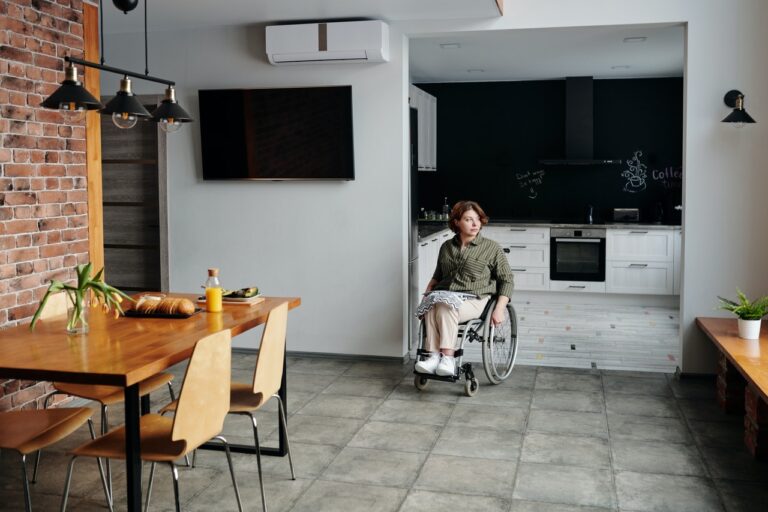
Universal Design was not offered when they built their home, and even though renovating the home for wheelchair accessibility often costs as much as $50,000, they felt it was financially better than the alternative. The project was entirely funded with home equity, so they didn’t even have to touch their retirement money, or the kid’s future inheritance. You see, Jack and Jill are like most American seniors, 90% of whom would rather live at home as long as possible and are willing to seek help to do that.

Read the rest of this entry »

Sensor Network to Protect the Elderly

Marge Skubic

Marge Skubic developed a remote sensor network to monitor seniors’ activity and baseline health. Click image for credits and larger version

System monitors seniors’ health in the comfort of their own homes

By Marlene Cimons, National Science Foundation, December 6, 2012

Many elderly dread the prospect that chronic medical issues will force them to leave their homes for an assisted living facility or nursing home, making them dependent upon others for their care and personal needs. Sometime in the near future, however, new technology could help them remain in their homes longer, perhaps indefinitely, without having to give up their independence.

“Our goal is to keep people in their private homes for as long as possible,” says Marjorie Skubic, professor of electrical and computer engineering at the University of Missouri. “The idea is to detect functional decline or early signs of illness, so we can identify problems when they are very small and proactively address them before they become catastrophic. That way, mom won’t have to leave her home.” Read the rest of this entry »

Smart Car Features for Older Drivers

Nearly Nine in 10 Seniors Drive a Car that Doesn’t Fit their Aging Needs

AAA research helps “silver tsunami” match vehicle features to health concerns

Click to read about the future of driverless cars.

This photo by Henry Fountain pictures one of Google’s fleet of self-driving vehicles. The Lexus hybrid has a range-finder on top but otherwise looks reasonably conventional. We may eventually be able to buy cars that drive themselves (see comment below), and three states already license experimental models for operation on public roads, but until they’re commercially available, AAA offers advice on selecting car features for older drivers.

Washington, D.C., (Dec. 3, 2012) – With nearly 90 percent of motorists 65 and older suffering from health issues that affect driving safety, finding a car that not only adapts to conditions, such as lack of flexibility or muscle strength, while maintaining safety and comfort can be difficult. Data from a new AAA survey also reveals that only one in 10 senior drivers with aging health issues are driving a vehicle that has features like keyless entry and larger dashboard controls that can assist with such conditions.

To better equip the “silver tsunami” for driving safety and comfort, AAA has updated its Smart Features for Older Drivers resource to address a broader range of health conditions and include new data on 2012 vehicle features. As a leading advocate for senior driver safety, AAA launched Smart Features for Older Drivers in partnership with the University of Florida’s Institute for Mobility, Activity and Participation in 2008. In the update, Smart Features identifies vehicle features that optimize older driver safety and comfort, lists current vehicles with those features, and allows users to explore their individual needs through an interactive online tool.  Read the rest of this entry »

Before I die… Or before they do…

Before I die, from Candy Chang's TED talkToday I republish most of the content of a Huffington Post article that June Cohen wrote as part of TEDWeekends, a curated program about powerful “ideas worth spreading” each weekend.

The days between Thanksgiving and the New Year are always a time for reflection: On what’s been accomplished, on what remains ahead of us, and – most importantly – what matters most to you.

TED Fellow Candy Chang creates public art installations that explore the hidden landscape of near-death choices. Her work asks the audience, chalkboard-style, to fill in the blanks: “Before I die, I want to ________________.” Their answers have been, in turn: hilarious, heart-breaking, raw, real.

Read the rest of this entry »

How to Avoid Contractor Scams

If you or someone you know was effected by storm damage, please share this article. It offers advice for hiring a contractor that I submitted in August in response to an eLocal poll on this topic, and it’s based on my experience as communications director for a nonprofit homeowner advocacy organization that I co-founded. UPDATE: New advice links added (11/1/2012 )

Wayne Caswell, Modern Health Talk, wins eLocal's Most Articulate Award

Hurricane Sandy slammed into the northeast this week and did lots of damage to homes, so if you need repairs, this article is about how to avoid potential scams.

 Avoid “storm chasers,” those unscrupulous contractors that show up after disasters to prey on people in a hurry to fix their homes. You can recognize them by the magnet signs on their trucks and their temporary offices and phone numbers, and you may also notice yard signs popping up everywhere to promote their services.

Read the rest of this entry »

Senior Living Options & Costs Infographic

As seniors age, they may need help with daily tasks. Helping them decide on appropriate living arrangements is critical to staying safe and healthy. Investing in home modifications and some sort of medical alert system is a cost effective way for seniors to feel safe and secure while living an independent lifestyle, as this infographic suggests. Read the rest of this entry »

Universal Design Makes Home Accessible

Houzz Tour, by rom architecture studioThis Houzz home tour is about beautiful design that also addresses the mobility needs of all the family members — two of whom are wheelchair users. It offers more space for wheelchairs, easier access to appliances and a curbless shower that fits this Seattle family’s needs.

Karen Braitmayer and her husband needed more square footage and were resigned to building a second story before connecting with an architect who understood structural modifications and was able to provide more livability and accessibility in the same 1,830 sq.ft. footprint. The architect knew that “Adding a second story would have ruined the architectural character of the home and required multiple elevator trips a day.”

Read the rest of this entry »

Independent for Life

Book cover: Independent for Life: Homes and Neighborhoods for an Aging America

order online at University of Texas Press


From INDEPENDENT FOR LIFE: HOMES AND NEIGHBORHOODS FOR AN AGING AMERICA
edited by Henry Cisneros, Margaret Dyer-Chamberlain, and Jane Hickie, forward by John W. Rowe,
Copyright © 2012. Courtesy of the University of Texas Press.


Do you want to age independently in your own home and neighborhood? Staying home, aging in place, is most people’s preference, but most American housing and communities are not adapted to the needs of older people. And with the fastest population growth among people over 65, finding solutions for successful aging is important not only for individual families, but for our whole society. In Independent for Life, former HUD Secretary Henry Cisneros and a team of experts on aging, architecture, construction, health, finance, and politics assess the current state of housing and present new possibilities that realistically address the interrelated issues of housing, communities, services, and financial concerns.

Read the rest of this entry »

Follow Us
Twitter (@mhealthtalk)
Facebook (Please LIKE us)
Google+ (why)
RSS (real simple syndication)
Weekly Newsletter (on paper.li) YouTube (mHealthTalk channel) Pinterest (our pin boards)
 
See articles about the Consumer Electronics Show. Learn about our Consulting Services Modern Health Talk is a nominee in the SeniorHomes.com Best of the Web 2012 Wayne Caswell is a recognized eLocal expert panelist and often comments on their online polls.
Article Categories
Affiliate Partners
@mhealthtalk Recent Tweets

View more tweets